Consumer AI is popular, but only about 2% of consumers pay for it
New figures suggest consumer AI revenue grows slowly even as models improve, pushing major AI labs toward business customers instead.
By Eric Powlesland 3 min read
Consumer AI assistants are having a moment. Meta's personal assistant, Muse, and its plush mascot Jolly have turned into an unexpected hit. OpenAI has just launched Dots, a cartoon-style personal agent along similar lines. And Instinct, a newer assistant that books travel, makes restaurant reservations and cancels subscriptions, has reached a $10 billion valuation.
But as TechCrunch reported in an analysis this week, the money behind consumer AI looks much weaker than the buzz. Its argument is that the technology is not the problem. The problem is that consumers will only pay so much, and running AI costs a great deal.
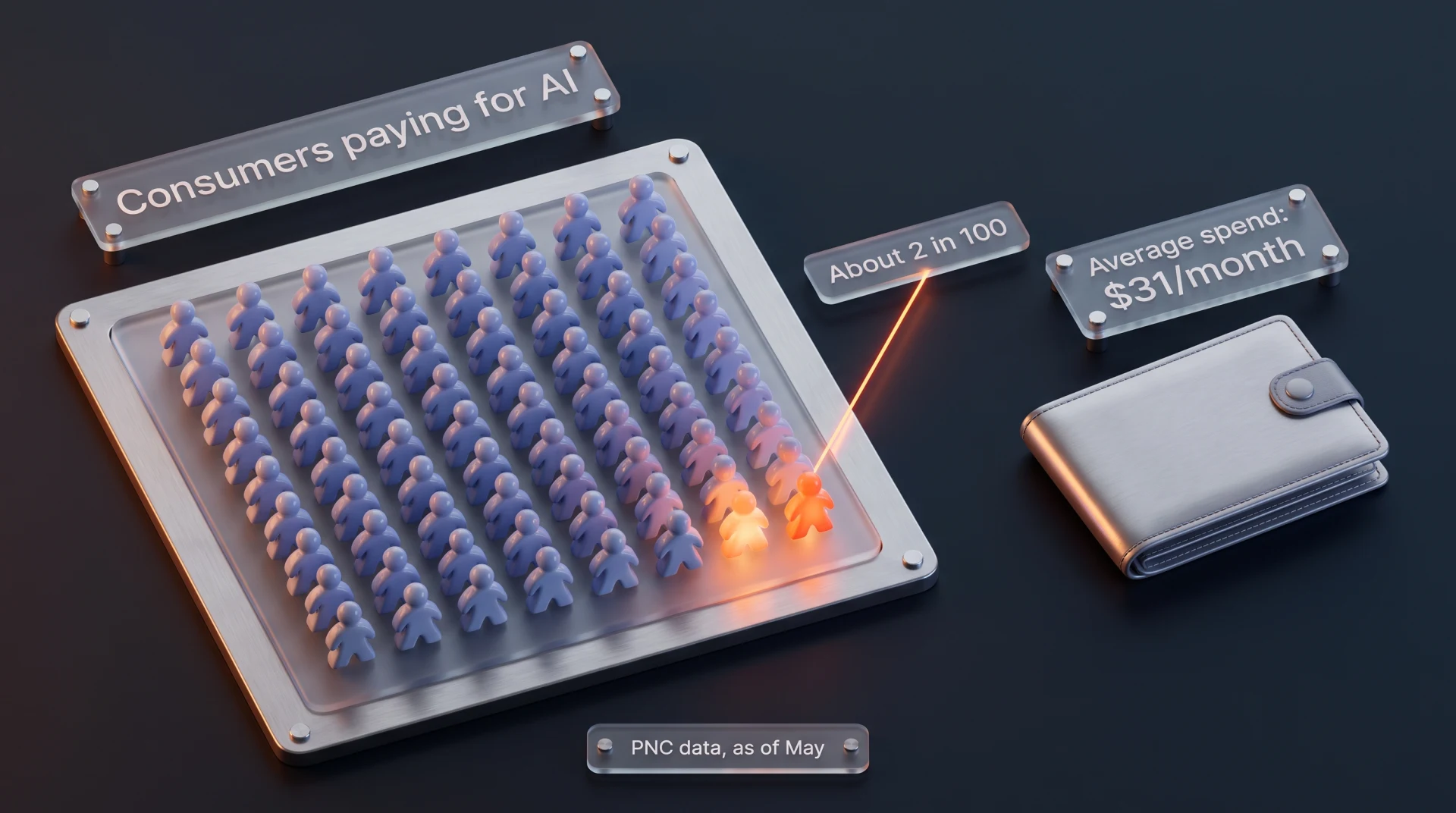
The numbers are modest. Andreessen Horowitz's semiannual State of Markets report, citing PNC research from this summer, found that as of May about 2.2% of consumers were paying for AI, spending an average of $31 a month. Bank of America found that roughly 3% of U.S. consumers paid for AI in March, up 40% from a year earlier. A September survey from Menlo was more upbeat: a quarter of adults use AI daily, and half of those users pay for it.
TechCrunch points out that both measures in the PNC data are growing at a steady, fairly flat pace. Big jumps in model quality barely change how many people pay or how much they spend. And because AI is expensive to run compared with older services like social networks, even hundreds of millions of paying users may not cover costs. By TechCrunch's math, even a Netflix-sized subscriber base at current spending would bring in less than a third of OpenAI's operating costs.
The result, according to the article, is a shift across the industry toward selling to businesses. OpenAI's move toward enterprise customers has reportedly paid off, with enterprise bookings said to have doubled since July. Even the Dots launch highlighted uses for software engineers and agency creatives. Meta is also said to be exploring business uses for Muse, while Instinct plans to take a cut of purchases made through its agent.
What it means for your business
For most small and mid-sized businesses, the practical point is simple: you are the customer the AI companies want. If consumers will not pay enough, vendors will look to business plans, team seats and enterprise contracts to make up the gap.
That has a few likely effects, though none are certain yet:
- Expect more attention on business tiers. New features may show up first, or only, in paid business plans.
- Free and cheap tools may change. Consumer products that are not making money tend to add ads, raise prices or shift features behind paywalls over time. Avoid building key workflows on a free personal account.
- You may have some bargaining power. If vendors are competing hard for business revenue, it is reasonable to ask about pricing, contract terms and how your data is handled before you commit.
If you are thinking about building an AI-powered product for consumers yourself, these figures are worth taking seriously. Only a small share of people pay for AI today, and what they pay has been growing slowly. A plan that depends on charging individuals a monthly subscription should account for that, and for the cost of running the AI behind it.
What to watch
Whether Muse, Dots and Instinct can turn popularity into lasting revenue is still an open question. Instinct's model of taking a share of purchases is one to keep an eye on, as is how Meta folds Muse into its advertising business. It is also not yet clear how business plans from the major labs will be priced as they lean harder into enterprise sales.