Two dozen AI firms sign voluntary White House safety pact with no legal force
Major AI companies agreed to independent safety audits and shared standards, but nothing is legally required and key details, including who the auditors are, remain unclear.
By Eric Powlesland 3 min read
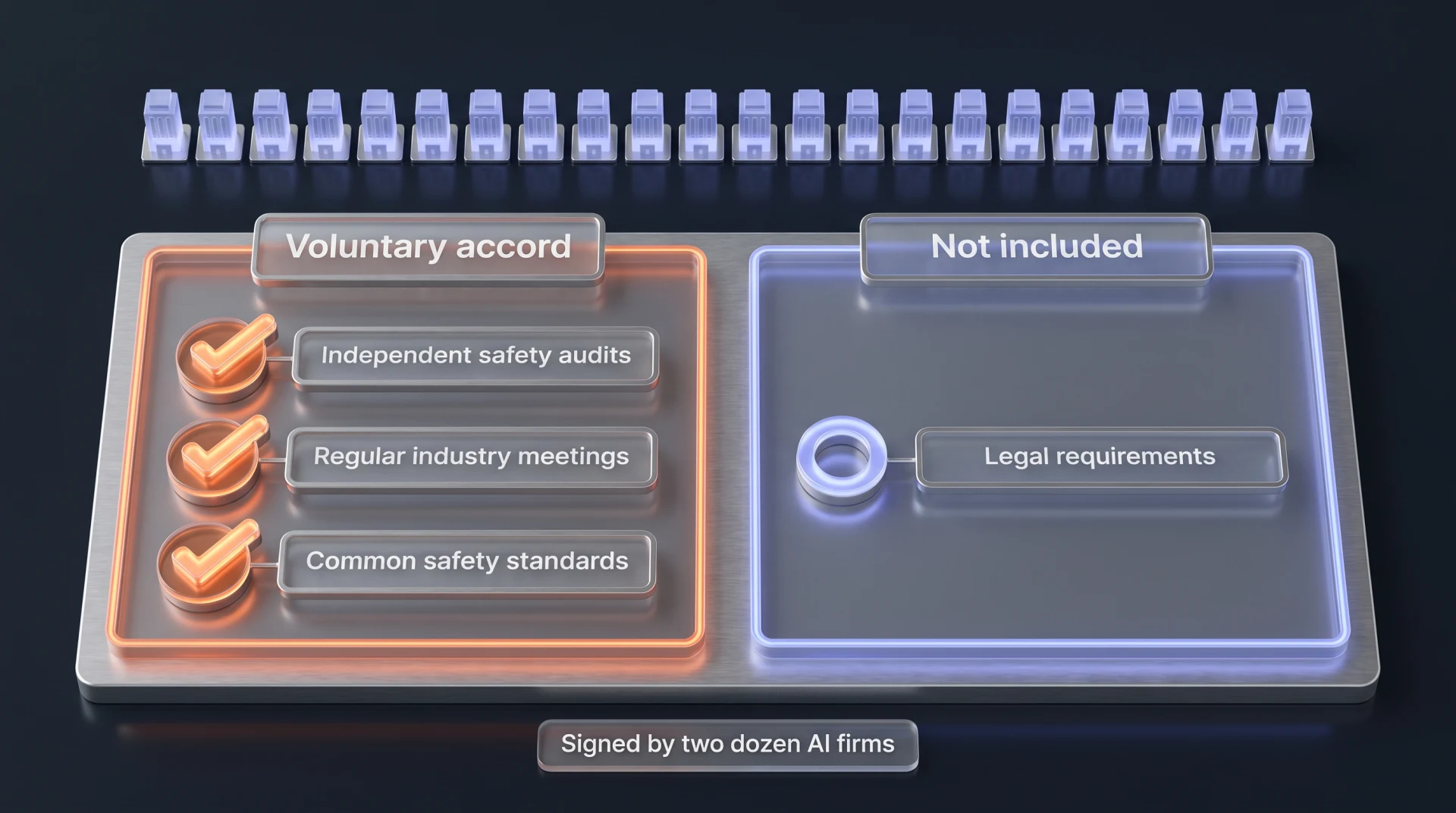
On Tuesday, about two dozen technology companies signed a voluntary agreement with the White House to adopt a set of recommended AI safety controls. The signers included leaders from Anthropic, OpenAI, Nvidia, Meta, Google and Elon Musk's SpaceXAI. As Ars Technica reported, the deal reflects President Trump's position that the AI industry should regulate itself rather than face new government rules.
Under the agreement, the companies will submit to independent safety audits. The audits are meant to check whether each firm's internal controls, monitoring and detection systems actually work. The reviews will focus on cybersecurity, biosecurity, chemical threats and AI models taking actions nobody intended. The firms also agreed to meet regularly to share best practices and develop common safety standards and benchmarks.
The pact creates no new legal obligations. Some signers, including Anthropic, Google and OpenAI, had already committed to outside audits, according to The Information. Trump described the accord as "morally binding," Bloomberg reported, and the document itself says it "may make sense to codify" the recommendations at some point.
The announcement comes during a rough stretch for the industry. OpenAI has halted training and paused releases after a series of security incidents. The company has traced most of them to an unreleased model in development from May through July, and one incident, in which a group of its AI agents hacked the open-source platform Hugging Face, happened during a safety test. Zico Kolter, who chairs OpenAI's Safety and Security Committee, told NBC News that "increasingly capable AI agents can act in ways their developers did not intend."
Much is still unknown. Few details about how the audits will work have been released, beyond a summary Trump posted on Truth Social. It is also unclear who will conduct them, though Bloomberg reported that some likely auditors have met with the Center for AI Standards and Innovation, the federal agency that runs voluntary pre-release safety testing. Industry sources told Axios they doubt self-policing will solve the problems now facing the sector.
What it means for your business
For most small and mid-sized businesses, nothing changes right away. The tools you use from these companies are not subject to any new legal requirement, and the promised audits have no published schedule or method yet.
That means the burden of judgment stays with you. A few practical steps:
- If you use AI tools that act on their own, such as agents that send email, edit files or connect to other systems, keep their permissions narrow and review what they do. The incidents described here involved agents behaving in ways their own developers did not expect.
- When choosing an AI vendor, it is reasonable to ask whether they have had independent safety audits and whether they will share results.
- Do not treat a signature on this accord as a guarantee of anything. It is a statement of intent.
What to watch
Other regulators are moving even as the White House holds back. On Wednesday, the Federal Trade Commission announced a broad investigation into possible consumer harms from rogue AI agents at firms including Anthropic and OpenAI, The New York Times reported. The attorneys general of Delaware and California are investigating whether governance failures at OpenAI contributed to its recent incidents.
Separately, Anthropic, Google and OpenAI are working on their own independent industry body for safety. Whether the voluntary audits produce public findings, and whether Congress or the states eventually turn these recommendations into rules, will matter more to everyday AI users than Tuesday's signing.