NVIDIA releases Kumo Tabular, an open model that predicts from tables without training
NVIDIA's free-for-commercial-use model reads a table of labeled examples and predicts outcomes for new rows, skipping the usual model-building process.
By Eric Powlesland 2 min read
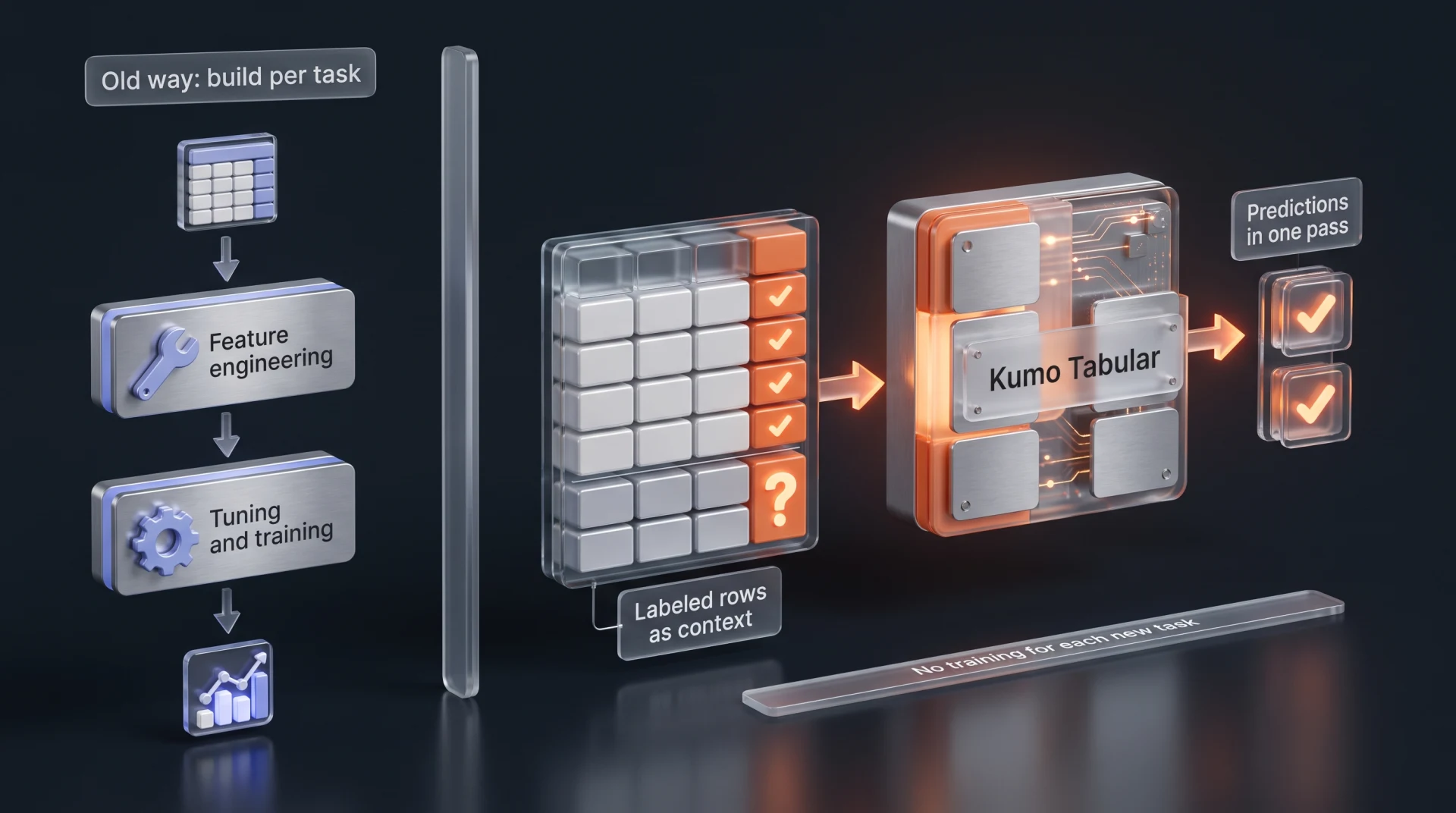
NVIDIA has released Kumo Tabular, an open AI model built to make predictions from the kind of data most businesses keep in tables: customer records, orders, transactions and claims. You give it a table where some rows already have the answer filled in, plus the rows you want predicted, and it returns its predictions in one step. NVIDIA says no training, tuning or feature engineering is required.
As NVIDIA explained on the Hugging Face Blog, the model handles both classification, such as whether a customer is likely to cancel, and regression, such as predicting a price or a demand figure. It comes in three sizes, from 28 million to 215 million parameters. It is released under the OpenMDW-1.1 license, which allows commercial use. The model weights are on Hugging Face, and the code is on GitHub.
The model learns from the labeled rows in the moment, much as a chatbot can pick up a task from a few examples in a prompt. Notably, NVIDIA trained it entirely on artificial tables generated by a program, designed to include real-world messiness like missing values and inconsistent records. NVIDIA reports that Kumo Tabular ranks first on four public benchmarks, TabArena, BeyondArena, TALENT and ScoringBench. On TabArena, it says the model ran about 17 times faster than a competing model called LimiX-2 on a single NVIDIA graphics card.
What it means for your business
Predicting churn, late payments, demand or pricing from historical records is one of the most common uses of machine learning. For about two decades, the standard approach has been to build a fresh model for each question. That means collecting examples, crafting the right inputs, adjusting settings and testing before anything goes live. For a small or mid-sized business, that work usually means hiring a data specialist or a consultant, and it often stops projects before they start.
A model that can produce predictions straight from a labeled table could make those projects cheaper and faster to try. A developer could test whether your sales or customer history actually predicts something useful in far less time than a traditional build.
Some honest caveats apply:
- This is not a point-and-click product. It runs through NVIDIA's software library and is designed for GPU hardware. You will still need someone technical to set it up and connect it to your data.
- The benchmark results are NVIDIA's own. They are encouraging, but independent testing will matter.
- It has limits. It works directly on numbers and categories only. Text, images and dates have to be converted first using built-in preprocessing. NVIDIA warns that accuracy may drop on tables much larger than its training range, or when the rows being predicted look different from the examples.
- Validation still matters. NVIDIA itself advises checking accuracy on your own held-out data before relying on the model.
If you have been holding off on a forecasting or customer-scoring project because a custom model seemed too expensive, this is worth raising with your developer or data partner. The license allows commercial use, which removes one common barrier.
What to watch
NVIDIA says it will release its training recipe and the tools it used to generate the artificial data soon. Independent comparisons against the established tree-based methods most firms use today will show whether the claimed gains hold up on real business data. It is also not yet clear how practical the model will be for teams without access to GPU hardware.