AMD to buy World Labs, Fei-Fei Li's world models startup, for $8.2 billion
The chipmaker is buying AI that simulates the physical world, aiming at robot training, a field where rival Nvidia currently leads.
By Eric Powlesland 3 min read
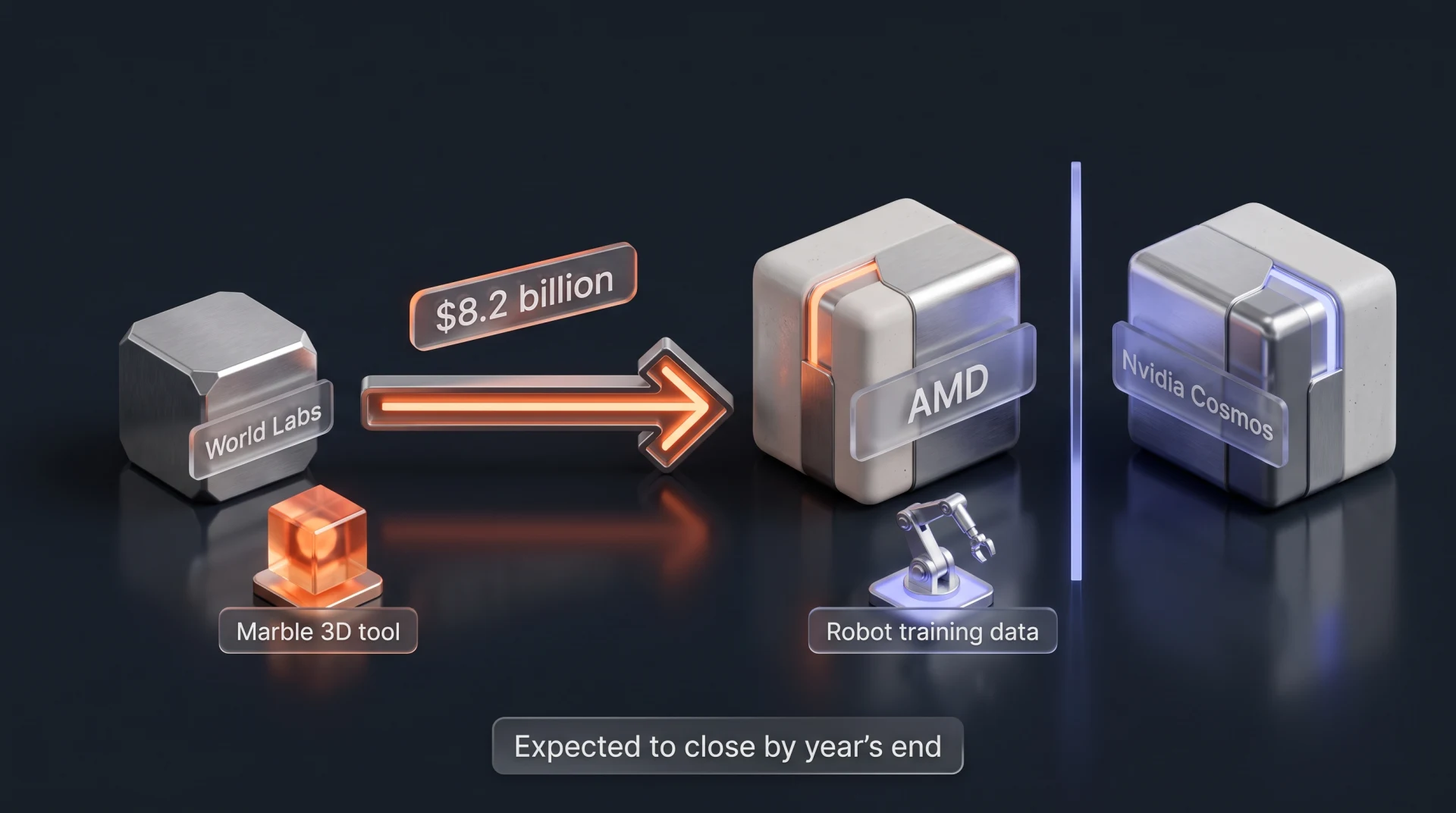
AMD has agreed to acquire World Labs, a young AI company that builds what are called world models, in a deal valued at $8.2 billion. As Ars Technica reported, the two companies expect the purchase to close by the end of the year, pending regulatory approval.
World Labs was founded in 2024 by computer vision scientist Fei-Fei Li, along with researchers Justin Johnson, Christoph Lassner and Ben Mildenhall. It launched with $230 million in funding, and AMD was one of the investors. The two companies had also partnered before, so the deal is less surprising than the speed of it. Ars noted that an acquisition this early is unusual for such a young company.
Under the agreement, Li will become executive vice president and chief scientist at AMD. Johnson and Mildenhall will keep leading the World Labs team as it moves inside AMD.
What a world model is
A world model is an AI system meant to give a useful, predictive simulation of the physical world. There are competing ways to build one, but many involve training on very large amounts of video.
World Labs' first tool open to the public, called Marble, takes that approach. It generates small 3D spaces that can be exported as 3D assets for film production, game development and other uses. The company has since released other models and tools, including one called Atlas.
Why AMD wants it
The bigger prize appears to be robotics. One reason investment has poured into world models is that they can generate synthetic data for training robots, so a robot can learn from simulated scenes rather than only real ones. Nvidia, AMD's main competitor in AI chips, has a strong lead here with its Cosmos models and related tools. AMD has released its own open source world model, Micro-World, but nothing that competes with Nvidia's full set of offerings.
AMD's own announcement leaned into that angle. "As AI expands into reasoning, robotics, simulation and physical AI, the demands on compute infrastructure become more diverse," the company said. It added that World Labs' expertise would help shape its future technology plans.
What it means for your business
For most small and mid-sized businesses, the direct impact is small for now. This is a deal between a chipmaker and a research-heavy AI company, and the results will mostly show up in the hardware and software that larger technology firms build on.
That said, a few groups should pay attention:
- Businesses that use 3D content. If you make product visuals, marketing scenes, games or video, Marble is one of the tools in this space. The source material does not say what will happen to Marble or Atlas once World Labs joins AMD, so it is worth not building critical workflows around them until that is clearer.
- Manufacturers, warehouses and logistics firms. Better tools for training robots in simulation are aimed squarely at you, even if the benefits arrive through equipment vendors over several years.
- Anyone buying AI services. Nvidia dominates the AI chip market. A stronger AMD gives the industry a more credible second option, which could matter over time for the cost and availability of the computing power behind the AI tools you use. That is a long-term possibility, not a near-term price change.
What to watch
- Whether regulators approve the deal on the expected timeline, by year's end.
- What AMD does with World Labs' existing creative tools, which drew attention at this year's SIGGRAPH computer graphics conference.
- Whether AMD builds a full robotics and simulation offering that can stand against Nvidia's Cosmos.