China weighs letting ByteDance and Alibaba buy restricted Nvidia chips for AI
Beijing has asked two of its largest tech firms for purchase plans for Nvidia gaming chips, as critics question Nvidia CEO Jensen Huang's sway over President Trump.
By Eric Powlesland 3 min read
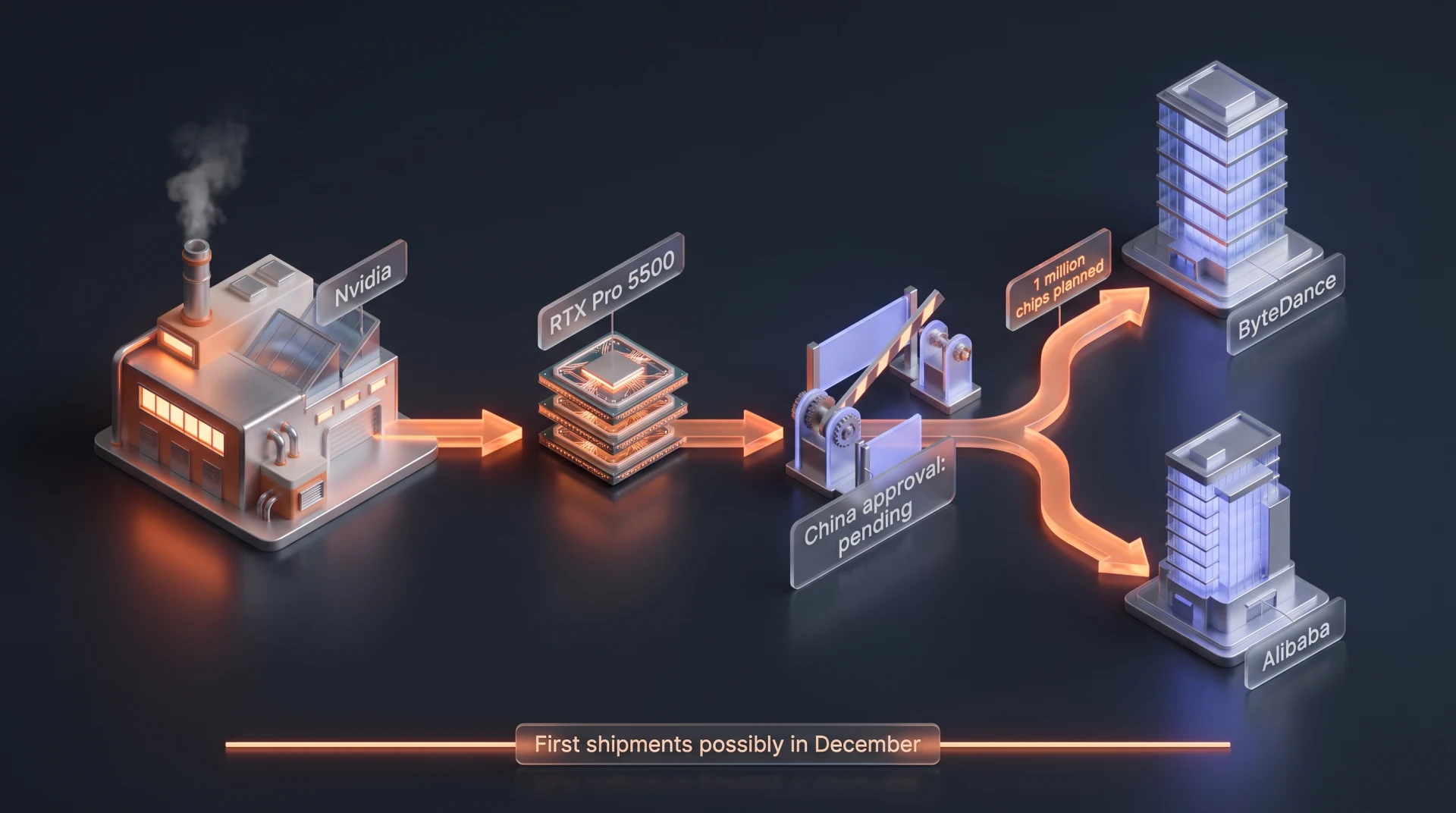
China is considering whether to let some of its biggest AI companies buy Nvidia chips that are currently barred from the country. Sources told The Information that China's tech regulator, the Ministry of Industry and Information Technology, asked Alibaba and ByteDance to submit plans for buying Nvidia's RTX Pro 5500. It is a gaming chip, but the expectation is that the firms would install it in servers to run popular AI models.
As Ars Technica reported, the stakes for Nvidia are large. If China approves, ByteDance reportedly plans to order 1 million chips, which would lock in two quarters' worth of Nvidia's projected sales. Nvidia is said to be preparing to ship first orders in December. China has not made a final decision, though sources say it intends to allow at least some chips in.
The news landed alongside a Trump-Xi summit where export controls were not discussed at all. A fragile trade truce was extended by only two months, and analysts expect new US controls could end it, possibly prompting China to cut off exports of rare earth minerals.
The Nvidia-White House question
Much of the debate is about Nvidia CEO Jensen Huang's influence on President Trump. Trump initially tightened Biden-era restrictions, including banning exports of Nvidia's H200 chips to China. After a dinner with Huang at Mar-a-Lago, he lifted that ban despite warnings from lawmakers and national security experts. Treasury Secretary Scott Bessent said the president is "completely aligned" with Huang.
Huang has said US export controls took Nvidia's share of China's advanced AI chip market from about 95 percent to zero. Sales there have been weak since: H200 sales made up less than 1 percent of Nvidia's data center revenue last quarter, and the company reportedly absorbed a $400 million hit in the first half of 2026 from unsold H200 chips.
Critics argue Nvidia's interest in selling more chips is shaping the administration's relaxed view of AI risk. An Nvidia spokesperson told Ars that the gaming chips in question are outdated, released nearly five years ago, and cannot be used to train AI.
What it means for your business
For most small and mid-sized businesses, the direct effect is small. You are not buying Nvidia server chips, and nothing here changes the AI tools you use today.
The indirect effects are worth keeping in mind:
- AI service costs depend on chip supply. Some experts worry that if too many chips flow to China, US data centers could eventually face tighter supply, which could push up costs for the cloud AI services businesses rent. For now, Nvidia's own numbers suggest the two markets are not competing: US firms do not want the older China-market chips because they can buy better ones. That could change as more US data centers come online.
- Trade tension affects hardware. A two-month truce is not much runway. If it collapses and rare earth exports are cut, that could ripple into the cost and availability of electronics generally. It is not clear yet whether or when that would happen.
- Do not count on federal AI rules. The administration's stance is clearly light on regulation. If you use AI with customer data or for decisions that matter, your own vetting of vendors and policies is likely to be the main safeguard for the foreseeable future.
What to watch
- Whether China formally approves the RTX Pro 5500 purchases, and whether shipments start in December as reported.
- Whether the trade truce survives past its two-month extension, and any new US export controls.
- Any move toward formal AI safety oversight in the US, which so far appears unlikely.