Anthropic says Claude found a Crispr-like enzyme system; scientists want lab proof
About 950 Claude agents sifted genomic databases in under a day and flagged an unusual enzyme family, but experts say whether it matters is still unknown.
By Eric Powlesland 3 min read
On September 23, Anthropic announced that its AI model Claude had flagged an enzyme system with features it described as reminiscent of Crispr, the Nobel Prize-winning gene-editing tool. As Wired reported, the finding is the first from a research group Anthropic formed earlier this year, and it has drawn both compliments and pointed skepticism from scientists.
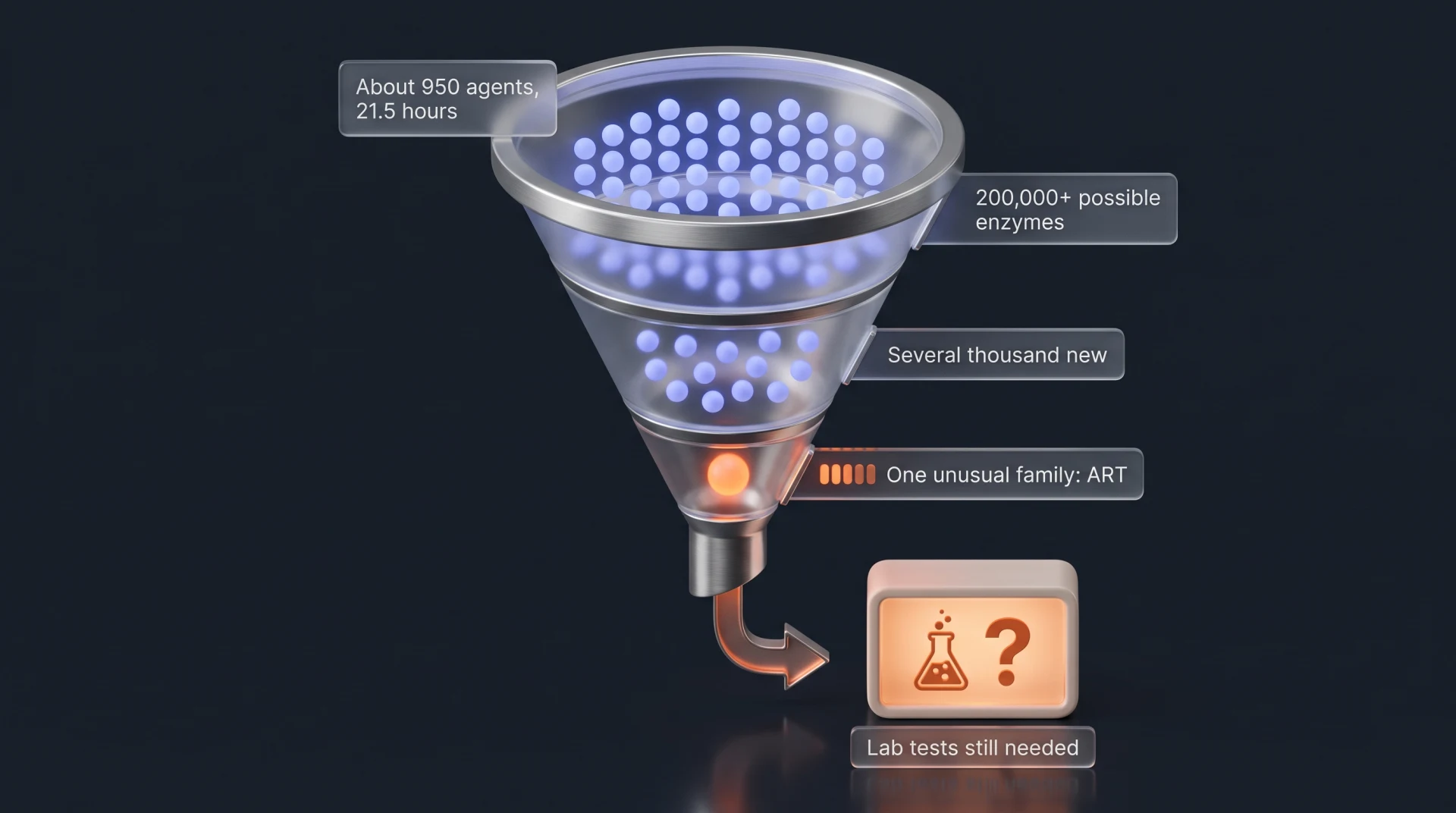
According to Anthropic, roughly 950 Claude agents working at the same time searched large genomic databases for new examples of reverse transcriptases. These are proteins that copy RNA into DNA. The agents first turned up more than 200,000 candidates, narrowed those to several thousand that looked new, and then found one unusual family sitting next to a long stretch of repeating DNA that resembles Crispr. The whole search took about 21.5 hours. Anthropic calls the system ART, short for array-associated reverse transcriptases. It is found in very large viruses that infect bacteria.
Anthropic itself says it does not yet know what the system does. Its technical report includes one physical experiment and has not been peer-reviewed. Whether ART can edit genes, and whether it would be useful if it can, remains open.
Several researchers urged caution. The enzyme itself had already been described in a 2021 paper by Texas A&M microbiologist Jason Gill and colleagues. What appears new is that Claude spotted the surrounding repeats that hint at a Crispr-like role. Seth Shipman of the Gladstone Institutes said he does not think this is a new Crispr system. "The novel thing is how they found it, not what it is," he told Wired. He also noted that human scientists were involved, so it is a stretch to say Claude made the discovery on its own.
Stanford's Le Cong compared it to scanning a beach for a diamond: the AI found something shiny, but only lab work can say whether it is a diamond or glass. Another concern raised in the piece is transparency. Outside scientists cannot see what Claude was trained on, which makes the work hard to evaluate or reproduce. Anthropic told the New York Times that Claude was not trained on user transcripts.
What it means for your business
For most small and mid-sized businesses, the direct impact here is close to zero. No new product, drug or service is coming out of this soon. Crispr itself took 25 years to go from first spotted sequences to a programmable tool, and there is still only one approved drug that uses it.
The more useful lesson is about what AI is actually good at today. The scientists quoted largely agree on one point: the speed was impressive. Mining genome databases for new reverse transcriptases can take months by hand, and many AI agents working in parallel did a version of it in a day. Gill put it simply: these models are better at spotting patterns than a person scanning by eye, but someone still needs a hypothesis to point them at.
That maps well onto ordinary business work. If you have a large pile of records, documents or data and a clear question, AI can help you sort and flag candidates quickly. What it does not do is confirm that what it flagged is real or valuable. A person still has to check.
It is also a reminder to read AI announcements carefully. A company press release and a peer-reviewed, lab-confirmed result are not the same thing.
What to watch
- Whether Anthropic's follow-up lab experiments show ART can actually cut or edit DNA.
- Whether the technical report goes through peer review.
- Whether other researchers can reproduce the search and its results.