Google DeepMind builds a watermark for AI-designed proteins
A new system called SynthIDBio hides a detectable signature inside protein sequences, aiming to help DNA suppliers spot which AI designs came from trusted labs.
By Eric Powlesland 3 min read
Google's DeepMind team has published a method for watermarking proteins designed by AI, a step aimed at making it easier to screen for biological threats. The research appeared Wednesday in Nature and was covered by Ars Technica.
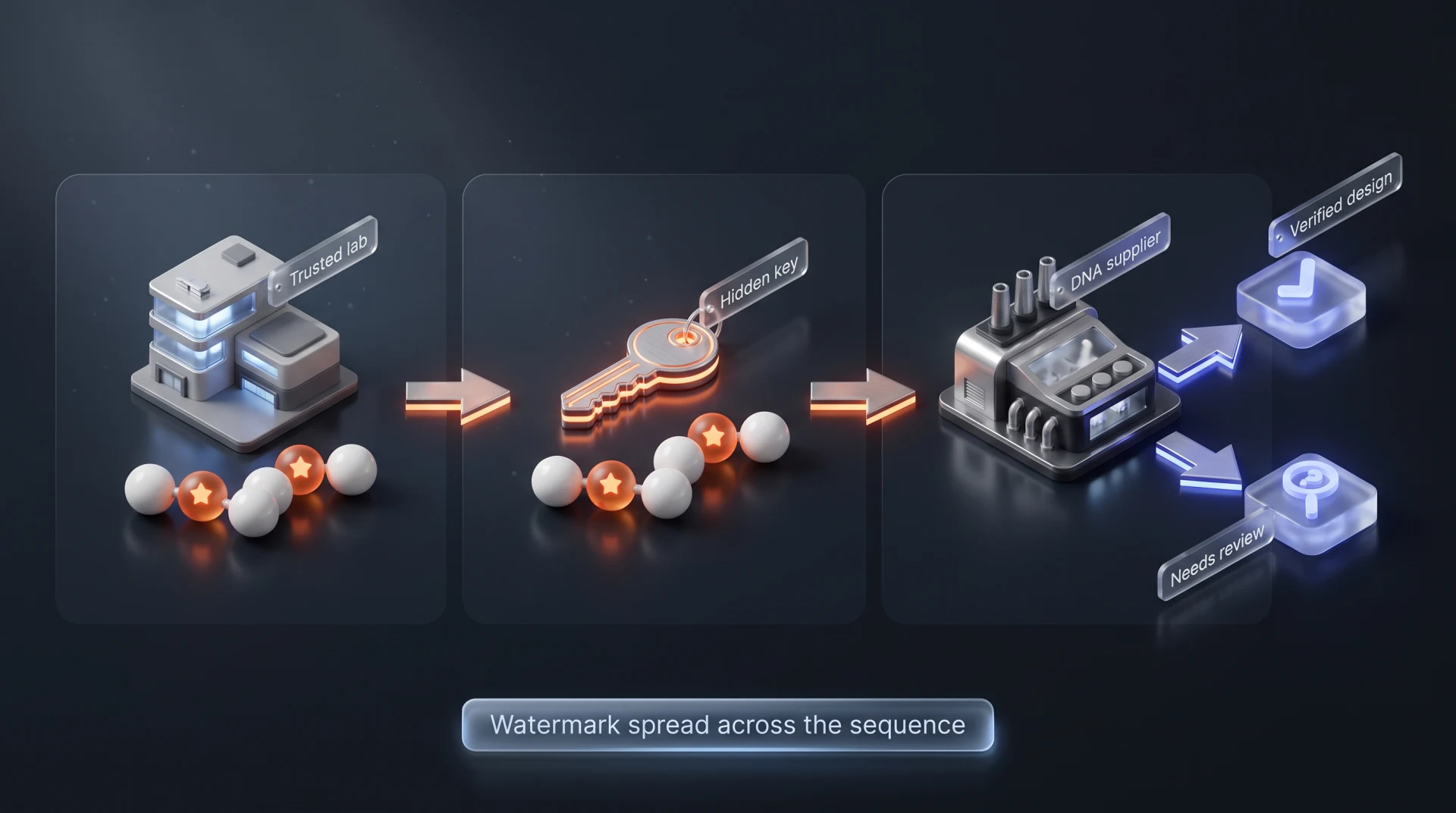
The problem it tries to solve is narrow but real. AI tools can now design proteins that do useful things, such as enzymes that break down plastic or molecules that block snake venom. The same tools could, in principle, be used to design harmful proteins. Companies that manufacture DNA to order normally screen each request against known viral and toxic sequences. An AI-designed protein does not match anything on file, so the screener has no way to judge it.
The watermark is meant to narrow that pile. It builds on SynthID, Google's existing technique for tagging AI-generated text and images by nudging the model's choices in a pattern that can be detected later with a key. The protein version, SynthIDBio, works alongside ProteinMPNN, a widely used protein design tool from the Baker Lab. As ProteinMPNN builds a protein one amino acid at a time, SynthIDBio suggests which amino acid to use at each step. If the suggestion would break the protein, it is rejected. The result is a signature scattered across the sequence that only shows up to someone who holds the key and scans the whole thing statistically.
In testing, the watermarked proteins still bound their intended targets, suggesting the tag does not cost much function. The team also released the detection software.
What it means for your business
For nearly every small and mid-sized business, the direct impact here is zero. This is infrastructure for biotech labs and DNA synthesis companies, not something that touches a storefront, a clinic or a contracting firm.
The reason it is worth two minutes of your attention is the pattern. This is one of the few cases where an AI company built a safety mechanism into the tool itself rather than bolting on a policy afterwards, and the approach is recognisable: tag the output at the moment it is created, then let downstream checkers sort trusted work from everything else.
You will see the same idea arrive in places that do affect you. Content provenance tags on AI-generated images and documents work on the same logic. If you are weighing AI vendors, it is a fair question to ask whether their outputs carry any verifiable marker, and whether you can check it yourself.
The honest caveats matter too. The Ars Technica piece lists several limits the researchers themselves flagged:
- The system is only as secure as whoever manages and distributes the keys.
- Very short proteins may not carry enough signal to be detected.
- A watermarked sequence can be diluted by fusing it to unmarked material.
- Many AI protein design tools do not use ProteinMPNN, and not all of them would work with this approach.
Detection is also statistical rather than a clean yes or no, which means someone has to choose a threshold and live with the false positives and false negatives that come with it. That is a familiar trade-off in any screening system, including fraud checks and spam filters your own business already relies on.
What to watch
Whether DNA synthesis companies actually adopt it. A watermark is only useful if the people screening orders hold the keys and run the checks, and that requires an agreement among universities, biotech firms and manufacturers that does not yet exist.
Whether the technique spreads beyond ProteinMPNN. Google has not said how it would handle design tools that build proteins differently.
And whether the same build-the-tag-in approach shows up in more everyday AI products. Ars Technica's own assessment was cautious, noting it is not clear the system will prove especially useful in its current form, but that it works at all is notable.